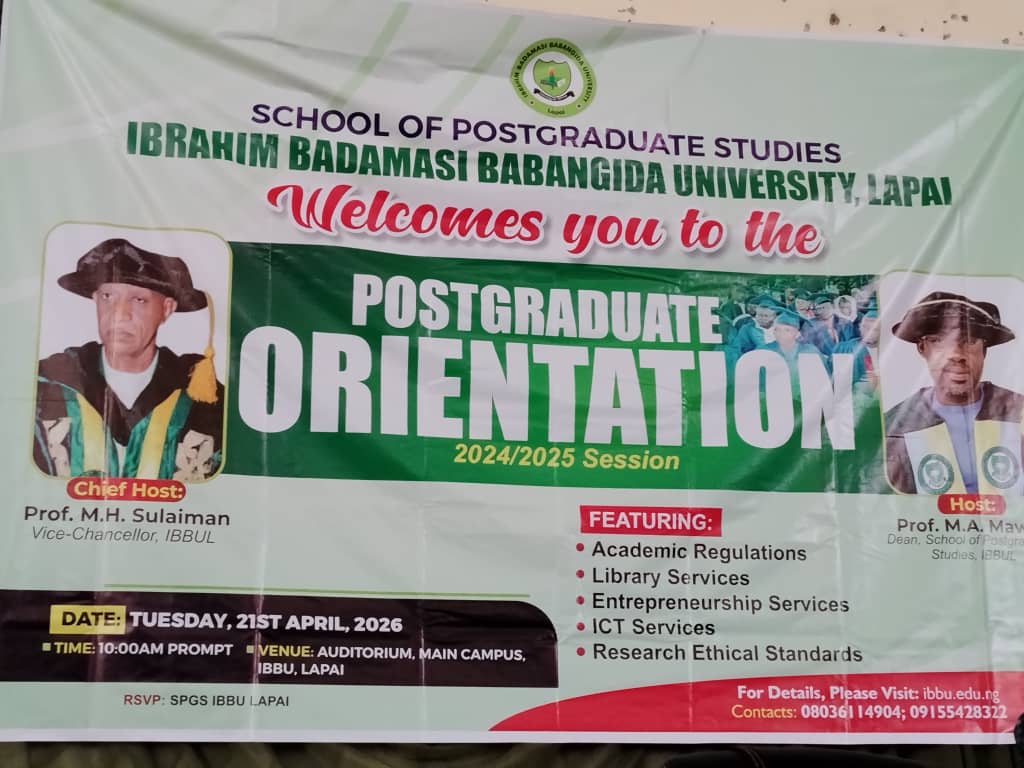
The School of Postgraduate Studies of Ibrahim Badamasi Babangida University has held its maiden orientation programme for both old and newly admitted postgraduate students, aimed at equipping them with the essential guidelines, academic requirements, and institutional procedures needed to successfully complete their programmes within the stipulated timeframe.
Declaring the orientation programme open, the Vice-Chancellor, Professor Mohammed Hadi Sulaiman, represented by the Deputy Vice-Chancellor (Academics), Professor Mohammed Aliyu Bello, welcomed postgraduate students to what he described as a historic moment in the University’s academic journey. He noted that the maiden postgraduate orientation for the 2024/2025 academic session reflects the Institution’s commitment to global best practices, academic excellence, and the continuous improvement of its postgraduate training framework.
He emphasised that postgraduate education goes beyond acquiring knowledge, urging students to see themselves as producers of knowledge who must question, investigate, innovate, and contribute meaningfully to academia, industry, governance, and entrepreneurship.
The Vice-Chancellor stressed the importance of academic discipline and integrity, maintaining a zero-tolerance stance on plagiarism, while also calling for dedication to high-impact research that addresses real-life challenges. He further encouraged intellectual curiosity, independent thinking, and active engagement beyond the classroom through seminars, collaborations, and extensive research, assuring that the University has strengthened its postgraduate support systems to ensure students succeed and graduate with competence, character, and confidence to make a difference.
Earlier in his welcome address, the Dean, School of Postgraduate Studies, Professor Mohammed Abubakar Mawoli, expressed delight in receiving the newly admitted postgraduate students for the 2024/2025 academic session, congratulating them on securing admission into the institution and welcoming them to a critical phase of their academic journey.
He explained that the orientation programme, though initially scheduled earlier in the session, had to be rescheduled due to logistical challenges and other University engagements, while appreciating the patience and understanding shown by the students.
Professor Mawoli noted that the initiative marks a significant step, as structured postgraduate orientation programmes have not been consistently held in many Nigerian universities due to the staggered nature of admissions.
He highlighted ongoing reforms under the current university administration aimed at strengthening postgraduate policies and improving research support systems.
According to him, postgraduate education now operates within a dynamic global research environment that demands interdisciplinary collaboration, the use of digital tools, and practical, solution-driven research.
He urged students to pursue innovative research that addresses real-life challenges, maintain effective communication with their supervisors, and adhere strictly to academic timelines. The Dean reaffirmed the commitment of the School of Postgraduate Studies to enhancing supervision capacity and providing the necessary support for academic excellence, while appreciating guest speakers, staff, and participants for their contributions to the success of the programme.
In their separate presentations, resource persons delivered insightful lectures on key areas critical to postgraduate success in the University.
Professor Ebenezer Oluseun Ogungbe spoke on academic regulations, outlining the rules, expectations, and procedures guiding postgraduate studies. Professor Olorunsanya Ayotunde O. examined the causes of prolonged postgraduate programmes and offered practical remedies to ensure timely completion.
Professor Musa Dickson Achimugu addressed ethical standards in postgraduate research in the era of artificial intelligence, emphasising integrity, originality, and responsible use of emerging technologies. Dr. Abubakar Aliyu Ango highlighted the critical role of the university library in supporting research, while the Deputy Director of ICT, Malam Abdullahi Enagi, discussed available ICT support services designed to enhance postgraduate learning and research efficiency.
In the same vein, the Deputy Director of the Entrepreneurship Centre, Dr. Fatima Zahra Usman, underscored the importance of integrating entrepreneurial skills into postgraduate research to promote innovation, self-reliance, and real-world impact.
In his goodwill message, the Registrar, Malam Idris Saleh Kusherki, commended the initiative of organizing a formal orientation programme for postgraduate students, describing it as timely and necessary.
He noted that although such programmes are not always common at the postgraduate level, the proposal, when presented to him, was carefully reviewed and found to be a valuable step toward properly guiding students on academic expectations and procedures.
He emphasised that postgraduate students require adequate orientation to navigate the demands of advanced studies, adding that the initiative aligns with emerging trends across university registries where structured guidance is increasingly prioritised.
The Registrar urged students to take full advantage of the programme by asking questions and seeking clarification to avoid challenges during their studies. He further highlighted ongoing policy reforms in postgraduate education within the University, commending the Dean of the School of Postgraduate Studies for his vision and leadership.
Malam Kusherki congratulated the students on their admission at a time of significant reforms and wished them a successful academic journey.
While delivering the closing remarks and vote of thanks, the Secretary of the PG School Hajiya Aisha Abubakar Gimba, expressed heartfelt appreciation to the University Management, guest speakers, and participants for their invaluable contributions to the success of the maiden orientation programme.
She commended the resource persons for their insightful presentations and encouraged postgraduate students to apply the knowledge gained throughout the sessions.
Hajiya Gimba further urged the students to remain committed, disciplined, and proactive in their academic pursuits, emphasizing the importance of adhering to guidelines and timelines for successful programme completion.
She wished all participants a rewarding postgraduate journey and reaffirmed the commitment of the School of Postgraduate Studies to supporting students in achieving academic excellence.
Highlight of the orientation programme was a blend of engaging and interactive segments, including a short drama presentation, captivating spoken word performances, and an insightful question-and-answer session, all of which enriched the experience and reinforced the key messages of the event at Ibrahim Badamasi Babangida University.